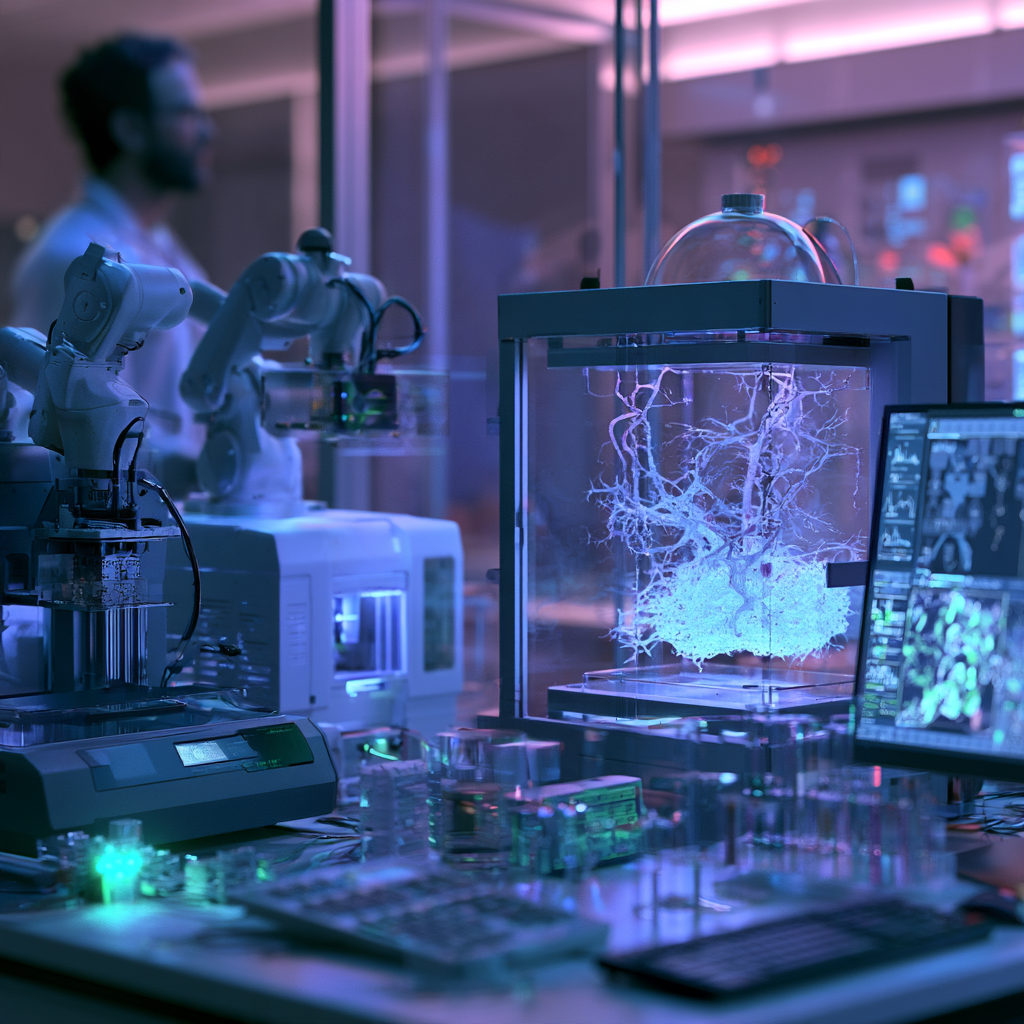
Vascularization: The Plumbing Problem Holding Back Printed Organs
Cells more than a few hundred microns from a blood supply starve. Here is how labs are learning to print the body’s plumbing.
Oxygen can only diffuse a short distance through tissue, roughly 100 to 200 micrometers. That’s about two human hairs. Any printed tissue thicker than that needs its own blood supply, or the cells in the middle die. This is the vascularization problem.
Four strategies that are working
- Sacrificial inks: print channels from a material that later dissolves, leaving hollow tubes that can be lined with endothelial cells. The Wyss Institute used this to build thick, perfusable tissue (Kolesky et al., PNAS, 2016).
- SWIFT: Harvard researchers printed vascular channels directly into dense living matrices built from organ building blocks (Skylar-Scott et al., Science Advances, 2019).
- Light-based printing: a Rice University and University of Washington team printed intricate multivascular networks, including a lung-mimicking air sac that oxygenated flowing blood (Grigoryan et al., Science, 2019).
- Let biology finish: print larger vessels, then coax cells to sprout their own capillaries.
Why it matters
Solve plumbing and you unlock thick tissue, and thick tissue is the road to organs. It’s also why AI-driven vessel design (see How AI Is Designing Better Bioprints) is one of the hottest crossovers in the field.
All three studies are linked in our Resources library.
Newsletter
Enjoyed this? Get the next one.
Breakthroughs, tools and weird-but-true science in your inbox. Free, no spam, unsubscribe anytime.