Printing the Future: AI, DNA and the Rise of Bioprinting
Printing the Future: AI, DNA and the Rise of Bioprinting
Imagine a hospital printing a kidney patch from your own cells, using a design an AI tuned to your DNA. Every piece of that picture exists in a lab today. Nobody has assembled them yet.
The printer that builds living things
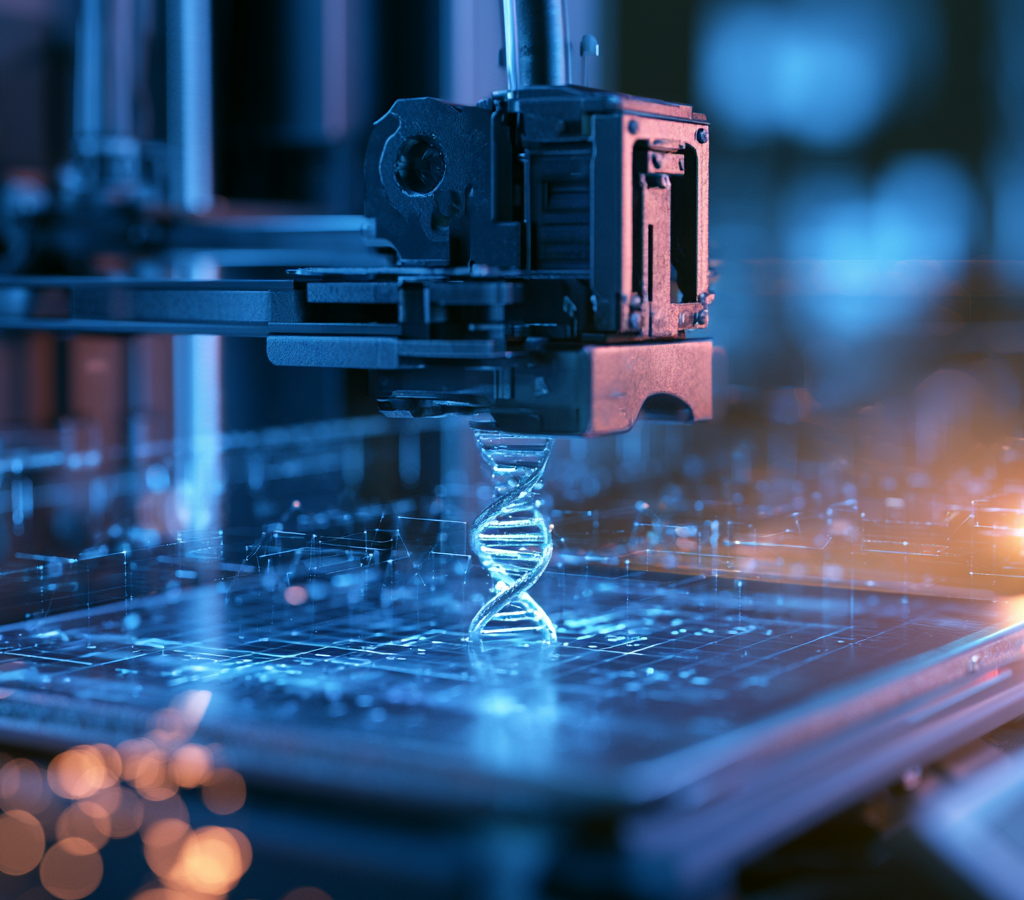
Bioprinting works like a 3D printer, except the ink is alive. A scanner builds a digital model of a tissue, the printer lays down cells suspended in a gel called bioink, and a bioreactor then matures the result into working tissue (UT Southwestern coverage).
The field is no longer small. A 2026 review counted more than 10,000 bioprinting papers published between 2015 and 2026 (Zdravković et al.). Simple tissues such as skin and cartilage are well along. Solid, blood-fed organs are not, and that gap is the whole story of why this matters: in the US, about 120,000 people wait for an organ while roughly 45,000 transplants happen each year (Rice University).
Three forces now push the field forward at once: smarter printing, better biological blueprints, and new ways to keep tissue young. The rest of this article follows each one.
AI takes the controls
Bioprinting is fiddly. Pressure, temperature, nozzle speed and bioink thickness all change whether cells survive the trip, and small errors compound across thousands of layers. Machine learning is built for exactly this kind of tuning.
Reviews describe AI predicting good printing conditions, computer vision spotting errors as they happen, and robotics placing bioink more precisely, though quality control and scaling remain open problems (Ozbolat group review).
The growth is striking. Papers at the intersection of bioprinting and AI rose from 1 in 2015 to 136 in 2025, a 136-fold jump, while AI research overall grew about 11.6-fold (Zdravković et al.). Those authors argue the field is heading toward “AI-native” bioprinting: systems that keep learning, sense the print through several channels at once, and adjust themselves in a closed loop.
The far end of that road is the self-driving bioprinting lab: a connected setup that grows cells, mixes bioink on demand, prints, matures tissue in intelligent bioreactors, and even assists robotic transplantation (Biofabrication perspective, Jan 2026). It is a vision paper today, not a product.
Reading the blueprint
Only about 2% of the human genome codes for proteins. The other 98% regulates when, where and how strongly genes switch on, and it has long been called the genome’s dark matter (Gizmodo).
Google DeepMind’s AlphaGenome, introduced in June 2025 and published in Nature in January 2026, targets that regulatory code. It reads up to one million DNA letters at once and predicts thousands of molecular properties at single-letter resolution, including gene expression, splicing, chromatin accessibility and 3D genome structure (DeepMind). It beat the best external models on 22 of 24 single-sequence tests, and it can score a mutation by comparing predictions for the changed and unchanged sequence.
The limits are real. Experts note the model is not yet validated for predicting an individual person’s genome, and that biology’s training data is often too small and unstandardized (GenomeWeb). Think of it as a powerful microscope for research, not a diagnostic you can order.
Where DNA meets the printer
This is the section where the research ends and informed speculation begins. No one has yet shown a genome model improving a bioprinted organ. But the connections are easy to see.
- Better cells. Printed tissue is only as good as its cells. Models that predict how regulatory DNA changes gene activity could help engineers choose and tune cell lines, so a printed liver cell behaves like a liver cell. DeepMind itself points to designing synthetic DNA that switches a gene on in one cell type but not another, such as nerve but not muscle (DeepMind).
- Safer cells. Scoring a donor or edited cell’s variants before printing could flag changes that disturb healthy gene regulation.
- Personal tissue. A patient’s own cells are the route to avoiding rejection. Once genome models are validated for individual genomes, which they are not yet, printing could be tuned to the person.
- Better disease models. Bioprinted tumors that mimic a patient’s cancer, analyzed with AI, are already an active research area (Artificial Intelligence in Health, 2026).
In short, the printer needs a blueprint for the cells as well as for the shape. Genome AI is starting to supply it.
The blood-vessel problem
A printed tissue thicker than a thin slab dies without a blood supply. Researchers have said it plainly: you cannot scale up bioprinted tissue without scaling up its vasculature. In 2025 a Stanford team published tools in Science that design organ-scale vascular trees and turn them into print instructions, with the aim of combining cells and vessels at organ scale (News-Medical).
Government money is now chasing the goal. ARPA-H’s PRINT program backs on-demand bioprinted organs:
- A Wake Forest Institute for Regenerative Medicine team won up to $24.8 million over five years to bioprint vascularized kidney tissue (Newswise).
- UT Southwestern received nearly $25 million to build transplant-ready liver tissue, a project named VITAL, with the aim of ending lifelong anti-rejection drugs (D Magazine).
The stakes are concrete. Nearly 10,000 people were on the US liver waiting list as of September 2024, and about 31% die before an organ arrives (same source). Funding is released in stages tied to milestones, so progress will be measurable.
Regeneration and longevity
Printing new tissue is one way to fight decline. Another is to make existing cells act younger. Partial epigenetic reprogramming briefly switches on a subset of the Yamanaka factors to reset a cell’s age markers without erasing what kind of cell it is.
That idea reached people in 2026. Life Biosciences, co-founded by Harvard’s David Sinclair, received FDA clearance in late January for a Phase 1 trial of ER-100, aimed at glaucoma and a form of optic-nerve damage called NAION (Fortune). The therapy uses three of the four factors, leaves out the cancer-linked c-Myc, and can be switched off with an antibiotic (Scientific American via Pulse). One report says the first patient was dosed in March, with early results expected from late 2026 into 2027, and safety, not vision, as the main goal (Live in the Future).
The regeneration link is direct. Printed tissues age and fail like any other, so a reprogramming tool could one day refresh the cells used in them. Meanwhile, in situ bioprinting, which prints repair material straight onto a wound, is named among the next-wave approaches for wound healing, alongside AI-assisted and 4D printing (Zdravković et al.).
AI enters here too. Retro Biosciences is reported to be building AI-engineered reprogramming factors, though it has not said whether they will reach its clinical programs (Live in the Future).
Reality check
Transplant-ready, widely available printed organs remain out of reach. Researchers have printed animal organs and human tissue samples, but a functional human organ is still the field’s holy grail (D Magazine). Treat any headline announcing the first printed, fully working human organ with caution until it appears in a peer-reviewed paper or a regulator’s record.
Three other limits matter:
- Data. AI is only as good as its training data, and biology’s datasets are often small and messy (Gizmodo).
- Safety. Full reprogramming produces tumors in mice, which is why trials start with careful, staggered dosing (Live in the Future).
- Imbalance. A 2026 review mapping AI research across the bioprinting pipeline found a sharp asymmetry, so progress is uneven across bioink design, monitoring and clinical translation (Zdravković et al.).
What to watch next: the first safety readouts from ER-100 around the turn of the year, milestone reports from the ARPA-H kidney and liver teams, and whether genome models get validated for individual patients.
Sources
All pages opened or retrieved October 30, 2026.
- The Next Phase of 3D Bioprinting: AI-Native Systems (J. Funct. Biomater., July 2026)
- The Synergy of AI and 3D Bioprinting (Adv. Funct. Mater., 2026)
- Self-driving bioprinting laboratories (Biofabrication, Jan 2026)
- Advances in 3D bioprinting and AI for tumor modeling (Artificial Intelligence in Health, 2026)
- AlphaGenome: AI for better understanding the genome (Google DeepMind)
- GenomeWeb on AlphaGenome and Gizmodo on AlphaGenome
- Realistic blood vessel structures (Stanford)
- Rice University on ARPA-H PRINT, WFIRM award, UT Southwestern liver award
- Fortune on Life Biosciences, Scientific American via Pulse, Live in the Future (secondary source for dosing date and timelines)
Enjoyed this? Get the next one.
Breakthroughs, tools and weird-but-true science in your inbox. Free, no spam, unsubscribe anytime.