
When AI Agents Enter the Wet Lab: The Next Leap in Bioprinting
For years, artificial intelligence in biology mostly lived upstream of the experiment. It searched papers, predicted protein structures, ranked drug targets and suggested which combination of variables a scientist might test next. The wet lab remained the boundary. A model could recommend an experiment, but a human still had to prepare the cells, calibrate the equipment, run the assay and decide what the result meant.
That boundary is beginning to move.
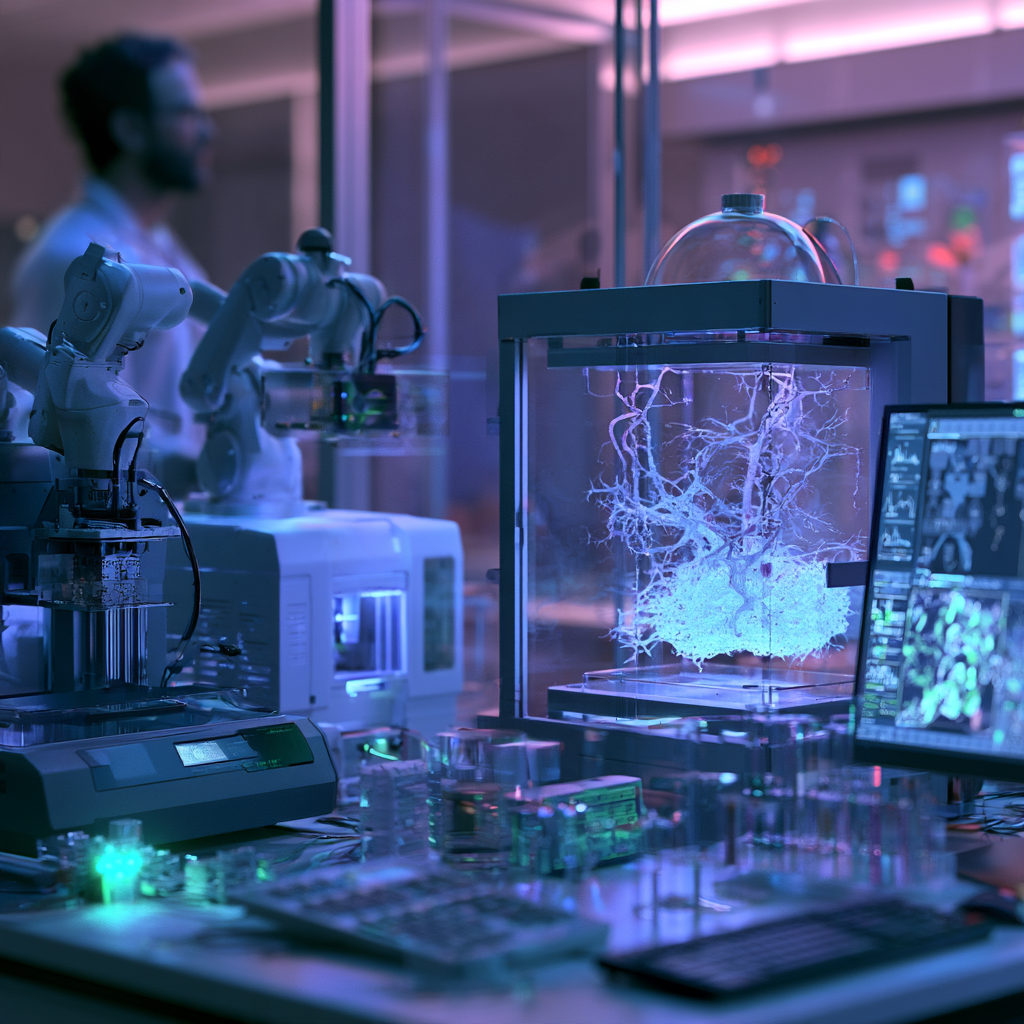
AI agents are being connected to laboratory software, robotics, liquid handlers, imaging systems and analytical instruments. In September 2026, Anthropic confirmed that it had established a Bay Area wet lab for physical biology work, arguing that the final test in biology still happens in real experiments—not only in computer simulations. The move is notable not because one AI company has opened a lab, but because it captures a wider shift: AI developers increasingly want their systems to participate in the full scientific loop. (Reuters)
The emerging loop looks like this:
- An agent reviews prior results and scientific literature.
- It proposes the next experiment.
- Laboratory automation executes the protocol.
- Sensors, microscopes and assays measure the outcome.
- The agent interprets the data and selects the next experiment.
That fifth step changes everything. Traditional automation repeats a procedure. A closed-loop system changes the procedure in response to evidence.
AI at Maryland | Transforming Health Care Through Bioprinting
Why bioprinting is unusually suited to this model
Bioprinting is a massive search problem disguised as a printing problem. The final construct depends on an interacting set of variables: cell type, cell density, bioink chemistry, viscosity, nozzle diameter, extrusion pressure, crosslinking method, print speed, geometry, oxygen transport, nutrient diffusion and post-print culture conditions. Improving one parameter can damage another. A construct with excellent shape fidelity may expose cells to excessive shear stress. A softer hydrogel may improve cell behavior but collapse before maturation.
A human team can test these variables, but only a tiny fraction of the possible combinations. An AI-directed laboratory could explore the design space more strategically. Instead of printing hundreds of nearly arbitrary variations, the system could use each result to decide which next experiment would reduce uncertainty fastest.
Imagine an agent tasked with improving a vascularized tissue patch. It could compare microscopy, mechanical testing and cell-viability data from each print; detect that a promising geometry is failing because diffusion drops at a particular thickness; adjust channel spacing and bioink composition; then queue the revised design for the next run. The printer becomes one component of a learning system.
This is already more than theory in neighboring disciplines. ChemCrow combined a large language model with 18 chemistry tools and demonstrated planning and execution across synthesis and materials tasks. In materials science, autonomous laboratories have connected computation, robotics, synthesis and characterization into iterative discovery workflows. These systems remain limited and sometimes controversial, but they demonstrate the basic architecture: prediction becomes much more valuable when it can be tested and corrected in the physical world. (Nature Machine Intelligence, Nature)
The most important opportunity is reproducibility
The exciting headline is autonomous discovery. The nearer-term value may be better experimental discipline.
Wet-lab work contains countless small decisions that are easy to omit from a paper or protocol: how long a material sat at room temperature, the precise age of a cell culture, whether a nozzle was partially obstructed, how a technician interpreted an ambiguous endpoint. Connected instruments can capture more of that context automatically. Agents can check whether a protocol was followed, identify drift across runs and flag results that should not be compared.
In bioprinting, where biological variability and machine variability collide, that audit trail could be transformative. The system should not merely record the intended protocol. It should record what the equipment actually did.
What should never be delegated blindly
An agent can optimize the wrong objective with extraordinary efficiency. If it is rewarded for print fidelity alone, it may favor conditions that harm long-term biological function. If the assay is noisy, the agent may learn the noise. If a model misreads a paper or invents a reagent property, robotic execution can turn a language error into a physical error.
This is why the wet-lab agent needs a permission structure, not just an intelligence layer. Safe systems will require:
- hard limits on temperature, pressure, volumes and permitted reagents;
- validated protocols and machine-readable safety rules;
- human approval for novel or high-risk procedures;
- independent checks before irreversible actions;
- complete logs linking every decision to data, models and instrument output;
- biological containment that does not depend on an AI model behaving correctly.
The scientist remains responsible for the question, the meaning of the endpoint and the consequences of the work. The agent can accelerate iteration, but it cannot supply scientific judgment simply by producing more experiments.
The real transition: from digital twin to experimental twin
Bioprinting companies often talk about digital twins—computational representations of tissue, equipment or manufacturing processes. The next step is an experimental twin: a continuously updated model that learns from each physical run and proposes the next one.
That could shorten the path from an interesting print to a reproducible manufacturing process. It may help researchers identify why a tissue construct succeeds on Tuesday and fails on Friday. It could make organoids, tissue models and eventually implantable constructs more consistent. It may also let smaller laboratories use sophisticated experimental strategies that once required large multidisciplinary teams.
The wet lab is not disappearing. It is becoming programmable.
And in bioprinting, the winner may not be the organization with the most impressive single print. It may be the one that builds the fastest, safest and most informative loop between an idea, a living experiment and the next better idea.
The breakthrough is not an AI that knows biology. It is a laboratory that can learn from biology.
Leave a Reply