
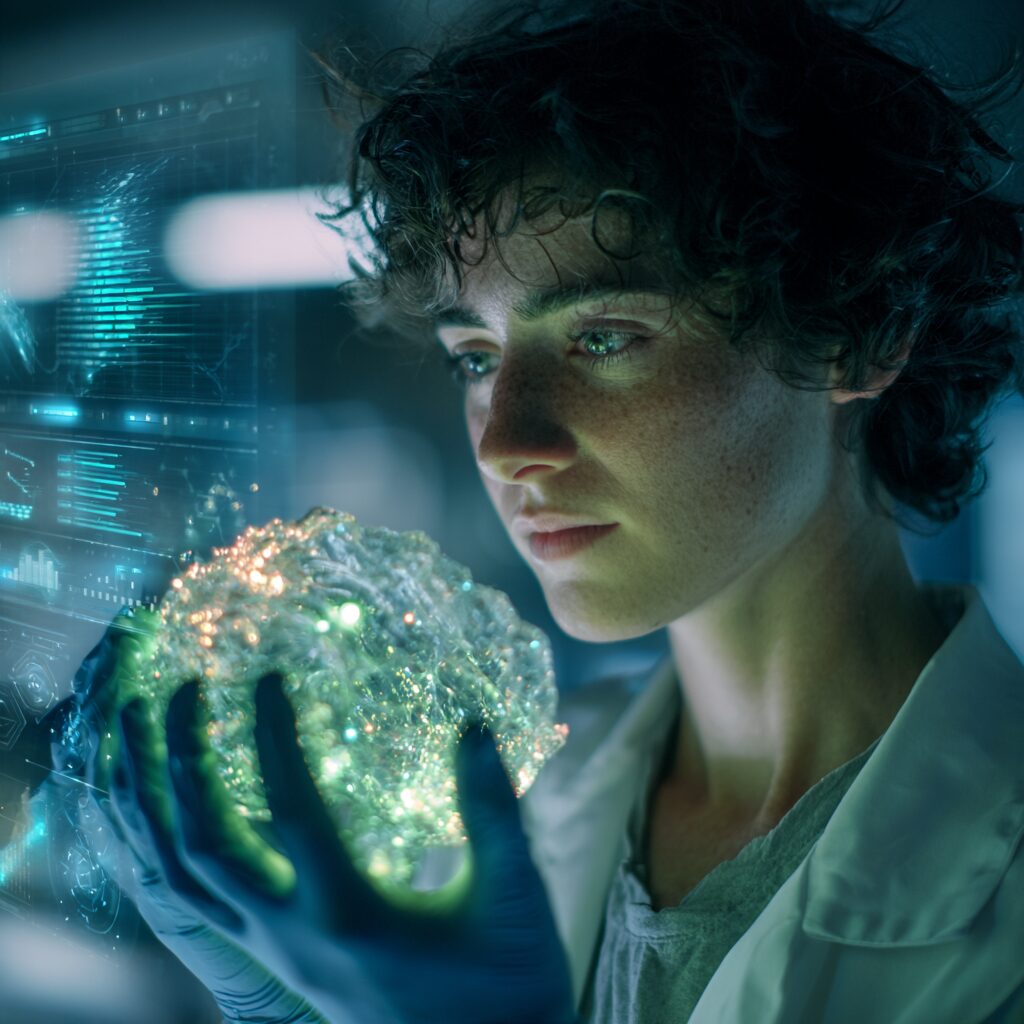
4D Bioprinting: Why the Future Isn’t Printing Organs — It’s Growing Them
For years, bioprinting has been framed as a manufacturing problem.
Print the right shape. Place the right cells. Stack the layers precisely enough, and—eventually—out comes an organ.
But biology doesn’t work like a factory.
Living tissue is dynamic. It folds, stretches, differentiates, migrates, and reorganizes itself over time. And that realization is pushing the field toward a radical shift—4D bioprinting, where time becomes the most important design variable.
This isn’t about better printers.
It’s about designing living systems that evolve.
4D Bioprinting – The Future of Healing
What “4D” Actually Means in Bioprinting
In traditional 3D bioprinting, you print a structure and hope it behaves.
In 4D bioprinting, you print something that is meant to change.
The fourth dimension is time—specifically, how a bioprinted construct transforms after printing in response to:
-
Cellular self-organization
-
Mechanical forces
-
Biochemical gradients
-
Environmental stimuli (temperature, pH, light, hydration)
Instead of forcing biology into a final shape, 4D bioprinting lets biology finish the job itself.
Why Static Tissues Fail
Here’s the uncomfortable truth:
Many bioprinted tissues fail not because the printer is inaccurate—but because the tissue is too perfect.
Static constructs struggle with:
-
Poor cell maturation
-
Limited functionality
-
Inability to adapt to physiological forces
-
Structural breakdown over time
Real organs are not rigid objects. They are constantly remodeling themselves.
When we print tissues that can’t change, we’re asking living cells to survive inside dead architecture.
The Core Idea: Print the Rules, Not the Result
4D bioprinting flips the workflow.
Instead of asking:
“What should this tissue look like when it’s done?”
Researchers ask:
“What conditions will cause this tissue to become what it needs to be?”
That means designing:
-
Smart bioinks that stiffen, soften, or degrade on cue
-
Scaffolds that fold or curl as cells apply force
-
Gradient-based designs that guide cell differentiation
-
Temporal release systems for growth factors and signals
The printed structure is no longer the final form—it’s a starting state.
Self-Assembly: Letting Cells Do What They Already Know How to Do
One of the most powerful aspects of 4D bioprinting is guided self-assembly.
Cells naturally:
-
Align into fibers
-
Form vascular networks
-
Establish polarity
-
Create layered structures
Instead of micromanaging every detail, 4D bioprinting provides:
-
Gentle constraints
-
Directional cues
-
Time-based signals
The tissue organizes itself, much like it does during embryonic development.
This is why many researchers now believe developmental biology, not mechanical engineering, is the real blueprint for organ printing.
Shape-Morphing Tissues: Printing Motion into Matter
Some 4D constructs are designed to physically change shape after printing.
Examples include:
-
Flat sheets that fold into tubular blood vessels
-
Soft lattices that contract as cells mature
-
Multi-layer prints that bend due to differential swelling
These transformations can be triggered by:
-
Hydration
-
Temperature changes
-
Enzymatic activity
-
Cellular traction forces
In other words, the tissue moves because it’s alive.
Why Time Beats Resolution
Early bioprinting competition focused on:
-
Micron-level precision
-
Print speed
-
Multi-material accuracy
But 4D bioprinting reframes the problem:
Perfect placement matters less than correct progression.
A tissue that starts “wrong” but matures correctly will outperform a tissue that starts “right” but can’t evolve.
This insight is reshaping how success is measured—from visual fidelity to functional maturation over time.
Applications That Suddenly Become Possible
4D bioprinting unlocks use cases that 3D printing struggles with:
🫀 Functional Organ Components
Heart muscle that strengthens with use
Blood vessels that adapt to flow
Liver tissue that self-organizes into lobules
🧠 Advanced Disease Models
Tumors that evolve realistically
Fibrotic tissue that stiffens over time
Inflammation-driven remodeling
🧬 Regenerative Medicine
Implants that integrate instead of resist
Scaffolds that disappear at the right moment
Tissues that mature inside the body
🧪 Drug Discovery
Long-term tissue response testing
Dynamic toxicity screening
Personalized tissue behavior modeling
The Big Bottleneck: Control Without Over-Control
The challenge with 4D bioprinting isn’t imagination—it’s restraint.
Too much control kills biological spontaneity.
Too little control leads to chaos.
The art lies in:
-
Designing permissive environments
-
Using minimal but precise constraints
-
Trusting biological processes to finish the work
This is less like machining—and more like gardening.
Where AI Fits In (Quietly, But Critically)
4D bioprinting generates massive complexity:
-
Nonlinear tissue changes
-
Multivariable feedback loops
-
Time-dependent outcomes
AI is increasingly used to:
-
Predict tissue evolution
-
Optimize temporal signals
-
Simulate maturation before printing
-
Identify failure patterns early
In many labs, the future bioprinting stack looks like:
Biology + Materials Science + AI + Time
The Philosophical Shift No One Talks About
4D bioprinting subtly changes how we think about creation.
We are no longer:
-
Assembling organs
-
Manufacturing life
We are:
-
Designing conditions for life to emerge
That’s a profound shift—from control to cooperation.
What This Means for the Future of Organ Printing
The first fully bioprinted transplantable organs likely won’t:
-
Come out of a printer finished
-
Look perfect on day one
-
Be “printed” in the traditional sense
They will be:
-
Grown
-
Trained
-
Conditioned
-
Allowed to mature over time
The printer will initiate the process—not complete it.
Final Thought
The future of bioprinting isn’t faster printers or finer resolution.
It’s patience.
It’s accepting that living systems need time, freedom, and the right conditions to become functional.
In that sense, 4D bioprinting isn’t just a technological leap—it’s a philosophical one.
We’re not printing organs anymore.
We’re learning how to grow them.
Leave a Reply