Bioprinting Is Closer Than You Think — Just Not Where You Expect
Bioprinted hearts are still a long way off. But bioprinted skin, cartilage, drug-testing models, and lab-grown meat are already here — and they explain where this technology actually makes money first.
The wrong picture in most people’s heads
Ask someone what bioprinting is, and they will picture the same scene: a printer humming in a hospital, a kidney sliding out on a tray, a surgeon plugging it in, and a waiting list disappearing overnight.
That scene is not a lie. It is just the wrong milestone to watch. It is the finish line of a very long race, and judging bioprinting by it makes the whole field look like science fiction — which is exactly why most people miss what is already happening.
Bioprinting is closer than you think. It is just arriving through side doors: a burn ward, a cosmetics lab, a drug company’s testing bench, a dental clinic, and a food startup’s kitchen. Those places do not make for dramatic movie scenes. They do make for real products, real trials, and real revenue — and they are teaching the field everything it needs to know before it can even attempt a complex organ.
This is the story of where bioprinting actually is, why the simple stuff wins first, and what to watch if you want to spot the next real breakthrough instead of the next press release.
What bioprinting actually is (and is not)
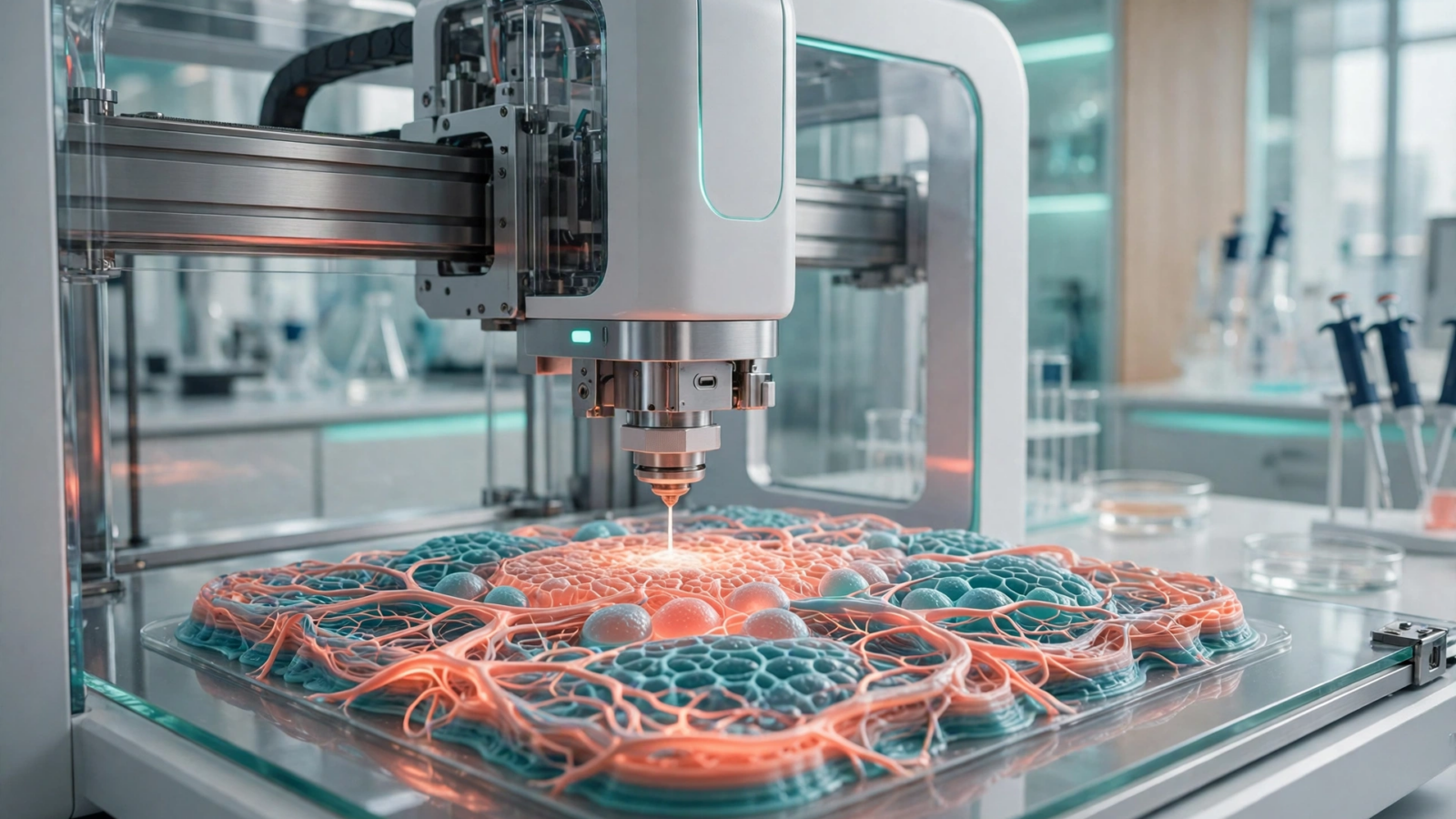
Strip away the hype and bioprinting is straightforward in concept, brutally hard in practice. A bioprinter deposits living cells, suspended in a material called bioink, layer by layer, following a digital model — much like a regular 3D printer, except the “ink” is alive and the “part” is supposed to keep living after it leaves the machine.
Bioink is usually a hydrogel: a water-rich gel that holds cells in place, feeds them, and gives them a scaffold to grow on. The cells themselves may come from the patient, from a donor, or from stem cells coaxed into a particular type. After printing, the construct goes into a bioreactor — a controlled incubator — to mature, the way a cast needs time to set, except here the setting is biological: cells multiply, connect, and start behaving like tissue.
There are three main ways to do the printing, and the choice matters:
- Extrusion bioprinting squeezes bioink through a nozzle, like a very precise piping bag. It is the workhorse: it handles thick, cell-dense inks and can build larger structures, but the pressure can stress fragile cells.
- Inkjet bioprinting fires tiny droplets, fast and precise, good for thin layers and patterns — but it struggles with dense inks and tall structures.
- Light-based bioprinting (stereolithography and laser-assisted methods) cures liquid bioink with light, or transfers cells with a laser pulse. It can achieve fine detail, which matters for the tiny channels that will one day become blood vessels, but it needs special light-sensitive inks.
None of these methods prints a working organ on demand. What they do print, increasingly well, is tissue: organized groups of cells with a job to do. The distinction between tissue and organ is the whole story of this field. A patch of skin is tissue. A kidney — with its filtration units, blood supply, nerves, and plumbing, all working in concert — is an organ. Bioprinting has crossed the first threshold. It has not crossed the second.
Why the simple tissues win first
There is a reason the earliest clinical progress is in skin, cartilage, and bone, and it is not a coincidence. It is physics.
Skin is thin, layered, and mostly flat. Bioprinted skin constructs — typically dermal fibroblasts and keratinocytes printed in thin layers — are being tested in clinical trials for wound healing, including for diabetic foot ulcers. These are not permanent replacement skin in the way a transplant is. They are closer to a smart, living bandage: a temporary graft that promotes healing and accelerates wound closure. The printed skin still lacks sweat glands, hair follicles, and the complex nerve networks of natural skin. That is a real limitation, and it is also beside the point for a burn or ulcer patient whose wound will not close. Early trials have reported improved epithelialization, better vascular integration, and favorable graft take rates — the percentage of a graft that survives and integrates with the wound bed. For wound care, that is a meaningful clinical win, not a demo.
Cartilage is even better suited to early bioprinting, for a counterintuitive reason: it has no blood vessels. That sounds like a disadvantage, and in the body it is — cartilage heals poorly precisely because it lacks a blood supply. But for a printer, no blood vessels means no plumbing problem to solve. Patient-specific auricular cartilage — the tissue of the outer ear — has been constructed from patients’ own expanded cartilage cells and implanted in human patients for ear reconstruction in microtia, a condition where the external ear is underdeveloped. It is a small, personal, visible win: a child gets an ear shaped from their own cells instead of carved from rib cartilage.
Bone sits in the middle. Bone scaffolds loaded with bone marrow stromal cells and bone-promoting factors have shown new bone formation in animal models with skull defects, and human trials are testing similar approaches for maxillofacial reconstruction and orthopedics, though most remain in early phases. Bone is harder than cartilage because it does need a blood supply eventually, and it needs mechanical strength. But a scaffold that guides the body’s own bone growth is a more forgiving target than a fully printed, fully functional bone.
A recent review in Trends in Biotechnology put the clinical picture in numbers: a search of ClinicalTrials.gov in March 2026 found ten trials using the keywords “bioprinted” or “bioprinting,” five of them active or recruiting. The interventional trials focused on cartilage, skin, the trachea, and a hormone-producing bioprosthetic model. Notably absent from human trials: the heart, liver, and kidney. That is not a failure. It is a map. It tells you exactly where the frontier is, and where it is not.
The quiet revolution: tissues that never go inside a patient
Here is the twist most coverage misses. The biggest near-term impact of bioprinting may not be implants at all. It may be models — tiny, living replicas of human tissue that never enter a body, but change how drugs, cosmetics, and diseases are studied.
Drug testing and disease modeling. Bioprinted tissue models and organoids — “mini-organs” grown from human cells — are now standard tools for testing new drugs and modeling diseases, replacing many animal trials in early research. A printed liver model, for example, can show how a drug is metabolized by human cells before it ever reaches a human volunteer. A printed tumor model can show how a particular patient’s cancer responds to a particular drug. This is more accurate than a flat layer of cells in a dish, because real tissue is three-dimensional: cells behave differently when they have neighbors above, below, and around them. Pharmaceutical companies are investing in bioprinted tissue platforms for high-throughput screening, disease modeling, and personalized medicine, often in collaboration with bioprinting firms. The pitch is not “we printed an organ.” It is “we made drug testing fail faster and cheaper, before it fails in people.”
Cosmetics and chemical testing. This is one of the most commercially mature uses, and the least glamorous to talk about. Bioprinted human skin models are used to test the safety and efficacy of cosmetics, personal care products, and household chemicals, as an alternative to animal testing. That aligns with both ethical pressure and regulatory shifts away from animal testing in several markets. L’Oréal’s long-running partnership with the French biotech firm Poietis to bioprint hair follicles — for product testing, and potentially for understanding hair loss — is a good example of the logic: if you can print the tissue you want to test on, you do not need to guess from an animal’s skin, and you do not need to test on people first.
Surgical planning and training. Printed anatomical models — not living tissue, but precise replicas built from a patient’s scans — let surgeons rehearse a complex procedure before the real operation. That is technically 3D printing rather than bioprinting, but it belongs in the same story: the printer earns trust in the operating room on models first, and the living-tissue version follows later, on the same digital workflow.
Dental and bone scaffolds. Custom dental implants, crowns, and cellular constructs for periodontal tissue regeneration are a natural fit: small, personal, and shaped to a scan. The same logic applies to bone scaffolds in maxillofacial surgery. Small, custom, and load-bearing in a limited way beats large, generic, and load-bearing in every way — at least for now.
None of these applications requires solving the hardest problem in bioprinting. All of them pay for solving the easier ones.
The other side door: food
If medicine is the serious face of bioprinting, food is the surprising one — and it may reach your plate before a printed organ reaches an operating room.
Cultivated meat companies are using bioprinting-related extrusion processes to give lab-grown meat structure: not just a mush of cells, but layers that resemble muscle and fat, with something like the bite of a steak rather than a nugget. Several of the companies working on this are based in Israel — Aleph Farms, Redefine Meat, and others — and they are using printing workflows to reduce cost and speed up production, two problems that matter more for food than for medicine. Food does not need to survive inside a body for decades. It needs to be safe, tasty, and cheap enough to sell. That lower bar, combined with a much larger market, is why food is a serious bioprinting story, not a gimmick.
The same logic applies to other non-medical uses: biosensors that integrate bioprinted biological components for diagnostics, and even textiles and materials research. Whenever the requirement is “living cells arranged in a useful pattern” rather than “a permanent replacement organ,” bioprinting has a shot.
The bottleneck that explains everything: blood vessels
If there is one technical problem that explains the entire timeline of bioprinting, it is vascularization — the formation of blood vessels.
Every cell in your body lives within a tiny distance of a capillary, because cells need oxygen and nutrients delivered and waste removed, constantly. A printed construct thicker than a few millimeters will starve in the middle unless it has its own plumbing. That is why thin tissues (skin), avascular tissues (cartilage), and small models (organoids) work first: they can survive by diffusion, or they are small enough that diffusion is enough.
Printed hearts, livers, and kidneys fail on this problem, not on the printing itself. Researchers can print the shape of a heart. They can print heart cells. What they cannot yet do reliably is print the dense, branching, multi-scale vascular network — from arteries down to capillaries — that would keep that heart alive, and then connect it to a patient’s circulation without clotting, leaking, or immune rejection.
Progress is real: prevascularized microarchitectures, endothelial cell-lined channels that help a graft connect to the host’s blood supply faster, and bioreactor maturation that encourages vessels to grow. But “progress” here means incremental, publishable steps, not a solved problem. Anyone who tells you a printed kidney is five years away is selling you a timeline, not a technology. The vascularization problem alone suggests the honest answer is “not yet, and not on a schedule anyone can credibly promise.”
The other bottlenecks are less dramatic but just as binding:
- Maturation. A printed construct is not a finished tissue on day one. It needs time in a bioreactor to develop strength, organization, and function — and time is expensive, variable, and hard to standardize.
- Reproducibility and scale. Printing one ear in a research lab is not the same as printing a thousand identical, sterile, quality-controlled grafts in a factory. Pharma and food applications live or die on this.
- Regulation. Bioprinted products sit at the intersection of devices, drugs, and advanced therapies. In Europe they may fall under Advanced Therapy Medicinal Products (ATMP) rules; in the US, the FDA pathway depends on whether the product is a device, a biologic, or a combination. There is no single, settled “bioprinting approval” — each product negotiates its own path, which slows everything and raises costs.
- Cost. Bioinks, sterile printing, cell culture, and quality control are expensive. The applications that win first are the ones where the price is justified: a drug that fails in testing is far more expensive than a printed model, and a wound that will not heal is far more expensive than a printed graft.
A realistic timeline — with the caveats attached
Timelines in bioprinting are where honest writers get into trouble, because every timeline is a bet. Here is a rough map, labeled as what it is: an editorial judgment based on where trials and products actually are today, not a promise.
Here now: Bioprinted skin models for testing, organoids and tissue models for drug screening and disease research, surgical planning models, dental and bone scaffolds in early clinical use, and cultivated meat prototypes moving toward commercial production.
Near term (the next few years): More and larger trials for skin grafts, cartilage reconstruction, and bone scaffolds; wider commercial use of printed tissue models in pharma; the first routinely used printed grafts for specific, well-defined defects — an ear, a patch of skin, a section of trachea — rather than whole organs.
Longer term (genuinely uncertain): Complex, vascularized tissues that survive long-term inside patients, and eventually partial organs or organ components — for example, hormone-producing implants or liver-assist constructs that supplement a failing organ rather than replacing it outright. Whole, transplantable hearts, livers, and kidneys remain the far horizon. They are the reason to keep funding the field. They are not the reason to invest in it as if they were imminent.
If a company, a headline, or a pitch deck collapses that timeline — if it promises a printed kidney next year, or a printed heart as a product rather than a research goal — treat that as a signal about the pitch, not about the science.
What this means if you are building, investing, or just watching
Bioprinting rewards a different kind of attention than most tech stories. The winners so far are not the companies with the most dramatic demo. They are the ones that picked a narrow, payable problem and solved it completely.
For builders and founders, the opportunity is often in the picks and shovels: better bioinks, more reliable printers, standardized tissue models sold as a service, quality control and regulatory expertise, and software that turns a scan into a printable, cell-friendly design. A company that sells a validated skin model to fifty cosmetics and pharma customers has a business. A company that promises a printed liver has a research project.
For investors and partners, the vetting questions are simple and revealing: Is the product a tissue or an organ? Does it need its own blood supply, and if so, how is that solved — not in theory, but in the data? Is there a clinical trial, a paying customer, or a regulatory pathway, or only a publication and a rendering? Who is the first customer, and what problem are they paying to solve today?
For patients and families, the honest message is both more modest and more hopeful than the headlines. If you need a skin graft, a cartilage repair, or a bone scaffold, bioprinting may already be part of your options, or may be soon — ask about trials, and ask what phase they are in. If you are on an organ waiting list, bioprinting is not yet an alternative, and anyone who implies otherwise is doing you a disservice. The work that will one day help you is being done right now, in the unglamorous places: in a wound-care trial, in a drug-testing lab, in a cartilage implant that gave a child an ear.
The bottom line
Bioprinting is closer than you think — just not where you expect.
It is not arriving as a miracle organ on a tray. It is arriving as a better skin graft for a burn patient, a cartilage implant shaped to one person’s ear, a drug test that uses human tissue instead of an animal, a cosmetics test that does not need an animal at all, and a steak that was never part of a cow.
Those are not consolation prizes. They are the foundation. Every one of them teaches the field something it needs for the harder problems: how to keep cells alive through printing, how to make a construct integrate with a body, how to manufacture living tissue reliably, and how to get a regulator to say yes.
The organ on a tray may come. But if you only watch for it, you will miss the decade in which bioprinting quietly becomes ordinary — in labs, in clinics, and in kitchens — long before it becomes miraculous.
This article is an editorial overview based on published research and clinical trial listings as of 2026, including the March 2026 ClinicalTrials.gov search reported in Trends in Biotechnology. It is not medical advice, and timelines for complex organs are editorial estimates, not guarantees. Specific treatments and trials should be discussed with a qualified clinician.
Enjoyed this? Get the next one.
Breakthroughs, tools and weird-but-true science in your inbox. Free, no spam, unsubscribe anytime.