
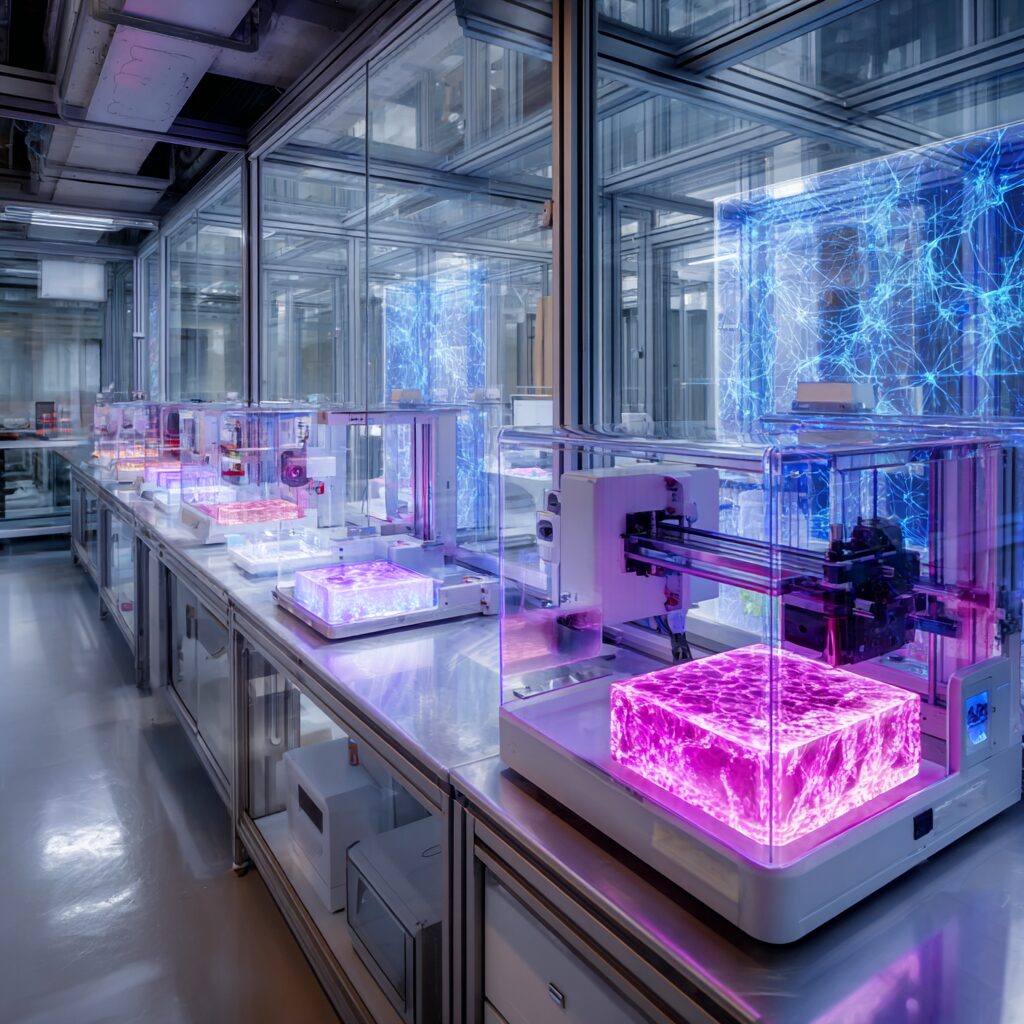
How Bioinks Are Changing the Future of Medicine
Beyond Plastic: Printing With Life
For decades, 3D printing was synonymous with plastic—rigid polymers, mechanical parts, and industrial components. That era is ending.
Bioprinting marks a profound shift: instead of extruding inert materials, scientists now print with life itself.
At the heart of this transformation are bioinks—complex, living formulations composed of:
-
Living cells (human, animal, or stem-cell derived)
-
Biomolecules such as proteins and growth factors
-
Supportive matrices that mimic the body’s extracellular environment
Unlike traditional printing materials, bioinks are not designed to hold shape forever. They are designed to live, grow, interact, and eventually disappear—leaving behind functional biological tissue.
This single innovation has redefined what medicine can build.
What Makes Bioinks Revolutionary
Bioinks are not just materials; they are engineered biological environments. Their power lies in their ability to recreate the conditions cells need to behave naturally.
To be effective, bioinks must accomplish several competing goals simultaneously:
1. Support Cell Viability
Cells must survive the printing process, which subjects them to:
-
Mechanical stress
-
Temperature variation
-
Shear forces
Advanced bioinks protect cells during extrusion and allow them to remain alive and functional after printing.
2. Encourage Tissue Formation
Cells are not passive building blocks. They communicate, migrate, and self-organize.
Bioinks are designed to:
-
Promote cell-to-cell signaling
-
Encourage differentiation into specific tissue types
-
Guide structural organization
In many cases, the printed structure is only a starting scaffold—the real tissue forms over time.
3. Degrade Safely and Predictably
Unlike plastic implants, bioinks are often designed to biodegrade as natural tissue forms.
This ensures:
-
No long-term foreign material remains
-
The body gradually replaces the scaffold with its own cells
-
Healing occurs without chronic inflammation
This balance—strong enough to support tissue, temporary enough to disappear—is one of bioengineering’s greatest challenges.
Breakthrough Applications Already Changing Medicine
While fully printed, transplantable organs remain a long-term goal, bioinks are already delivering real clinical and research impact today.
Regenerative Medicine and Tissue Repair
Bioinks are transforming how damaged tissue is treated.
Applications include:
-
Skin regeneration for burns and chronic wounds
-
Cartilage repair for joints and sports injuries
-
Bone scaffolds that encourage natural regrowth
Instead of replacing tissue with synthetic implants, medicine is learning how to stimulate the body to heal itself.
Drug Testing and Disease Modeling
One of the most immediate and powerful uses of bioinks is in organ-on-a-chip and tissue modeling.
Traditional drug testing relies on:
-
Animal models that don’t fully replicate human biology
-
Flat cell cultures that oversimplify complex systems
Bioprinted tissues allow researchers to:
-
Mimic human organs with unprecedented realism
-
Observe disease progression in controlled environments
-
Test drug responses safely and ethically
This approach reduces reliance on animal testing and improves the accuracy of early-stage drug development.
Personalized and Precision Medicine
Because bioinks can be created using a patient’s own cells, bioprinting opens the door to personalized healthcare.
Potential benefits include:
-
Reduced immune rejection
-
Tailored treatments based on individual biology
-
Faster healing and improved outcomes
In the future, a patient’s medical scan may directly inform a custom-printed biological solution designed specifically for them.
Ethical and Regulatory Frontiers
With great capability comes serious responsibility.
Bioinks raise important questions:
-
Who owns bioprinted tissue derived from human cells?
-
How do we regulate living medical products?
-
Where do we draw the line between therapy and enhancement?
Unlike traditional medical devices, bioprinted tissues blur boundaries between:
-
Product and organism
-
Tool and therapy
-
Manufacturing and biology
Ethical frameworks and regulatory pathways must evolve alongside the technology.
The Role of AI and Advanced Modeling
Bioinks do not advance alone. Their progress is increasingly driven by artificial intelligence and computational modeling.
AI helps researchers:
-
Predict how cells will behave over time
-
Optimize ink formulations
-
Simulate tissue growth before printing
This dramatically reduces trial-and-error and accelerates innovation.
In the future, AI-designed bioinks may be optimized at a cellular level—customized not only to tissue type, but to individual patients.
Bioreactors: Where Printed Life Matures
Printing is only the beginning.
After printing, bioprinted tissues often mature inside bioreactors—controlled environments that:
-
Supply nutrients and oxygen
-
Apply mechanical forces to encourage natural development
-
Replicate physiological conditions
Think of bioreactors as artificial wombs for tissue, where printed structures become functional biological systems.
The Road Ahead: From Possibility to Practice
The future of bioinks lies at the intersection of:
-
Materials science
-
Cell biology
-
Artificial intelligence
-
Robotics and automation
Key challenges still remain:
-
Scaling production reliably
-
Ensuring long-term safety
-
Navigating regulatory approval
-
Managing ethical implications
But progress is accelerating.
What once required years of research can now be iterated in weeks. What once existed only in theory is moving steadily toward clinical reality.
Why This Matters for the Future of Healthcare
Bioinks represent more than a new medical tool—they represent a paradigm shift.
Medicine is transitioning from:
-
Repair → Regeneration
-
Replacement → Restoration
-
Standardized → Personalized
Instead of adapting patients to treatments, treatments are being adapted to patients.
The Role of Bioprinting World
As bioprinting matures, the need for clear, responsible, and insightful coverage becomes critical.
Bioprinting World exists to:
-
Track scientific breakthroughs
-
Explain complex innovations clearly
-
Explore ethical and societal implications
-
Bridge the gap between research, medicine, and public understanding
The future of healthcare is being printed—layer by layer, cell by cell.
Understanding bioinks today means understanding how medicine itself will evolve tomorrow.
Leave a Reply