
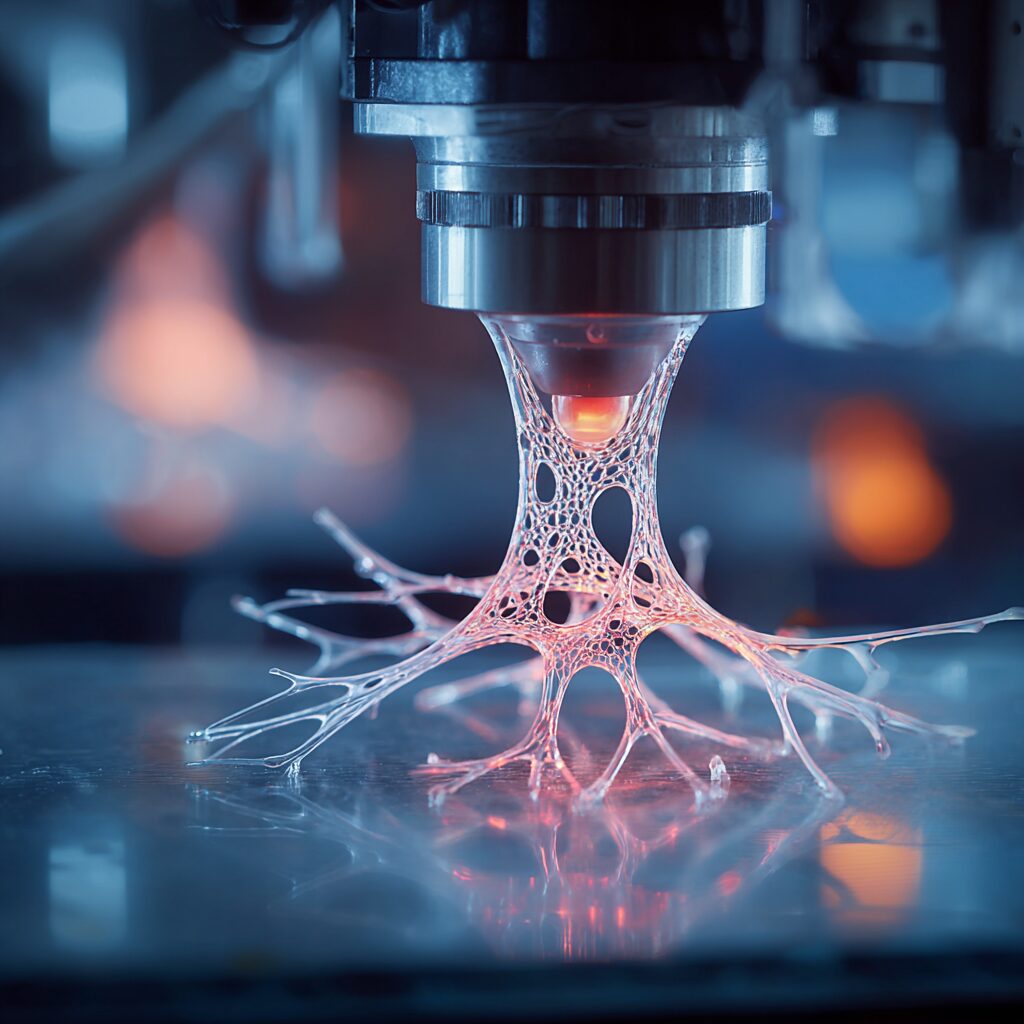
AI Meets Bioprinting: Designing Organs with Intelligent Algorithms
The convergence of artificial intelligence (AI) and 3D bioprinting is redefining the future of medicine. What once required decades of biological trial-and-error is now being accelerated by intelligent algorithms capable of designing, optimizing, and even predicting how living tissues will behave before they are ever printed.
This is not just innovation—it’s a fundamental shift toward programmable biology.
🧠 The New Frontier: From Manual Design to Intelligent Systems
Traditional bioprinting has long been limited by complexity.
Designing functional tissue requires:
- Precise cell placement
- Biomaterial compatibility
- Structural integrity
- Vascular (blood vessel) integration
Even the most advanced scientists faced a major bottleneck: design complexity.
Now, AI is removing that bottleneck.
What’s changing:
- Algorithms generate optimized organ structures in seconds
- AI simulates cell growth and behavior before printing
- Iteration happens digitally instead of biologically
👉 In simple terms:
We’re moving from trial-and-error biology → predictive, software-driven biology
⚙️ How AI Designs Living Tissue
AI doesn’t just “assist”—it actively creates and optimizes biological systems.
1. Generative Design for Organs
AI models (including generative AI) can:
- Design organ scaffolds
- Optimize geometry for nutrient flow
- Create structures impossible for humans to manually design
These systems learn from:
- Medical imaging (MRI, CT scans)
- Biological datasets
- Prior experimental outcomes
👉 Result: Organs designed for maximum functionality, not just structure
2. Simulation of Biological Processes
Before printing begins, AI can simulate:
- Cell growth patterns
- Tissue development
- Blood flow and oxygen diffusion
This drastically reduces:
- Failed experiments
- Costly lab time
- Risk in human trials
👉 Think of it as a “digital twin” of a living organ
3. Optimization of Bioinks and Materials
Bioinks (the materials used in bioprinting) are complex mixtures of:
- Living cells
- Hydrogels
- Growth factors
AI helps determine:
- Ideal material composition
- Printing temperature and pressure
- Structural stability over time
👉 This ensures higher survival rates of printed cells
4. Real-Time Printing Intelligence
Next-generation bioprinters are becoming AI-driven systems.
They can:
- Adjust printing parameters in real time
- Detect errors during fabrication
- Self-correct structural inconsistencies
👉 This creates autonomous bioprinting systems
🧬 Real-World Applications Already Emerging
AI-powered bioprinting is not theoretical—it’s happening now.
🔬 Drug Testing & Disease Modeling
Bioprinted tissues allow pharmaceutical companies to:
- Test drugs on human-like tissue
- Reduce reliance on animal testing
- Accelerate clinical timelines
AI improves accuracy by ensuring tissue realism.
❤️ Organ Transplantation
The ultimate goal: fully functional, transplantable organs.
AI enables:
- Personalized organ design based on patient data
- Matching immune compatibility
- Optimizing long-term functionality
👉 This could eliminate transplant waiting lists entirely.
🧪 Cancer Research
Scientists can now:
- Print tumor models
- Simulate cancer growth
- Test treatments in a controlled environment
AI helps predict:
- Tumor response to therapy
- Optimal treatment strategies
🚀 The Bigger Shift: Manufacturing Becomes Biological Software
This convergence is creating a new paradigm:
Biology is becoming software.
Instead of:
- Manufacturing physical products
We are now:
- Designing biological systems digitally
- Storing them as files
- Printing them anywhere in the world
👉 Just like 3D printing disrupted manufacturing,
AI + bioprinting will disrupt healthcare
💰 The Opportunity: A Trillion-Dollar Industry
The implications go far beyond medicine.
Emerging opportunities:
- Bioprinting labs and clinics
- AI-driven design platforms
- Bioink development companies
- Organ-on-demand services
- Personalized healthcare ecosystems
Early adopters—especially those combining AI + biotech + automation—will dominate this space.
⚖️ Challenges and Ethical Considerations
With great power comes serious responsibility.
Key concerns include:
- Regulation of bioprinted organs
- Ownership of biological designs
- Ethical boundaries of “creating life”
- Accessibility vs. inequality
As this technology evolves, society must answer:
👉 Just because we can design life… should we?
🌍 The Future: Programmable Human Biology
We are entering a world where:
- Organs can be upgraded
- Disease can be preemptively designed out
- Human biology becomes customizable
AI will not just help us treat disease—it may allow us to redesign the human body itself.
🔗 Final Insight
The convergence of AI and bioprinting represents one of the most asymmetric opportunities of our time.
It touches:
- Healthcare
- Technology
- Finance
- Ethics
- Human identity
And just like the internet transformed information…
👉 AI + bioprinting will transform life itself.
Leave a Reply